
If you’re researching how much does it cost to fit skirting boards in Ireland, you’re likely at decision stage.
Maybe your renovation is approaching second fix.
Maybe you’ve just installed new flooring.
Or maybe your builder has suggested “standard MDF” — and it doesn’t quite match the architectural finish you had in mind.
Across Ireland in 2026, renovation activity remains strong — especially in Dublin, Cork, Galway and the commuter belt. And one thing design-conscious homeowners are realising:
The details make the house feel complete.
Skirting boards aren’t just functional. They frame the room. They define proportion. They elevate the finish.
In this updated 2026 pricing guide, we’ll break down:
- How much to fit skirting board per metre
- How much for new skirting boards by material
- Labour costs in Ireland
- Whether it’s easy to change skirting boards yourself
- What actually lasts in Irish homes
Let’s get into the real numbers.
How Much Does It Cost to Fit Skirting Boards in Ireland?
Cost Per Metre (Supply + Fit)
The most common question is:
How much to fit skirting board per metre?
In Ireland in 2026, typical installed costs range from:
| Material | Supply Only (per metre) | Labour (per metre) | Supply + Fit Total |
|---|---|---|---|
| Budget MDF | €4 – €8 | €10 – €18 | €14 – €26 |
| Moisture-Resistant MDF | €7 – €12 | €12 – €20 | €19 – €32 |
| Solid Timber | €12 – €25 | €15 – €25 | €27 – €50 |
| High-Density Polyurethane | €18 – €35 | €12 – €20 | €30 – €55 |
Typical Labour Rates (2026)
- Per metre fitting: €10 – €20
- Carpenter day rate: €250 – €450 (Dublin at higher end)
If you’re asking specifically how much does it cost to fit skirting boards per metre, labour alone typically sits around €12–€18 per metre in most of Ireland.
How Much for New Skirting Boards? (Material Price Breakdown)
If you’re replacing existing trims, your material choice will heavily influence total cost — and long-term performance.
MDF Skirting Boards
Cost: €4 – €12 per metre
MDF remains the most widely used material in Ireland because it’s affordable and widely available.
Pros:
- Budget-friendly
- Smooth finish
- Easy to paint
Cons:
- Can swell with moisture
- Chips easily on corners
- Often lacks sharp architectural detail
In Ireland’s damp climate, standard MDF can struggle in hallways, kitchens, and ground floors if humidity levels fluctuate.
Solid Timber Skirting
Cost: €12 – €25+ per metre
Solid timber offers a natural premium aesthetic and suits period properties.
Pros:
- Authentic material
- Strong visual presence
- Can be stained or painted
Cons:
- Expands and contracts with moisture
- Requires sealing and maintenance
- Higher install cost
Timber is beautiful — but movement over time can create visible gaps.
High-Density Polyurethane Skirting (Premium Option)
Cost: €18 – €35 per metre
Increasingly specified in high-end renovations and modern classic interiors.
Pros:
- Moisture-resistant (ideal for Irish homes)
- Sharp European-style detail
- Paint-ready finish
- Lightweight = easier installation
- Won’t crack like plaster
For homeowners who want architectural detail without long-term cracking, this is often the sweet spot between plaster and MDF.
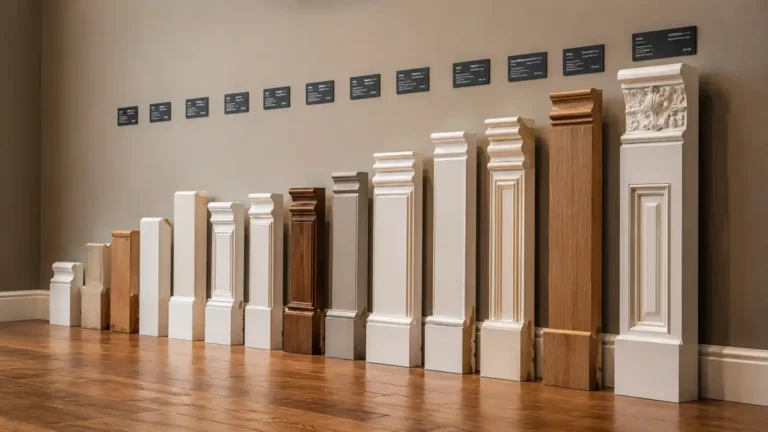
Material Comparison Table
| Material | Cost per metre | Durability | Moisture Resistance | Finish Quality |
|---|---|---|---|---|
| MDF | Low | Moderate | Low | Basic |
| Moisture-Resistant MDF | Medium | Moderate | Improved | Clean |
| Solid Timber | High | High | Moderate | Natural premium |
| High-Density Polyurethane | Premium | Very High | Excellent | Sharp architectural |
Labour Costs: What Do Carpenters Charge in Ireland?
Understanding labour is essential when calculating how much to fit skirting board per metre.
Per-Metre vs Day Rate
Some carpenters charge per metre. Others charge daily.
- Per metre: €10 – €20
- Day rate: €250 – €450
In Dublin and high-demand areas, expect higher rates.
What Affects Labour Pricing?
- Removal of old skirting
- Uneven walls
- Complex mitres and returns
- Large decorative profiles
- Priming/painting
- Working around fitted kitchens
Second-fix stage installations are usually more efficient and therefore more cost-effective.
Is It Easy to Change Skirting Boards?
Another common question:
Is it easy to change skirting boards?
The honest answer: sometimes.
When It’s DIY-Friendly
- Straight, modern walls
- Square-edge or minimal profiles
- Small rooms
- No complicated corners
With the right tools and patience, competent DIYers can achieve good results.
When You Should Hire a Professional
- Period properties
- Uneven plaster
- Decorative moulded profiles
- Large open-plan spaces
- High ceilings requiring proportion balance
The biggest risks DIYers face:
- Cracking plaster during removal
- Gaps in mitres
- Poor shadow lines
- Visible joins
For design-conscious renovations, professional fitting often delivers a noticeably sharper finish.
What Impacts Skirting Board Installation Costs?
Several factors influence total project pricing:
1. Profile Height & Thickness
Taller skirting (150mm–220mm) costs more in materials and labour.
2. Ceiling Height & Proportion
9ft+ ceilings require larger profiles for balance.
3. Wall Condition
Uneven walls increase labour time.
4. Corners & Returns
Every internal and external corner adds cutting time.
5. Painting
Factory-primed vs fully finished affects labour.
6. Material Weight
Heavier materials increase handling time.
Remember:
Details make the house feel complete.
Skirting size and profile directly influence perceived quality.
Cost Example: 3-Bed Semi in Dublin (2026 Scenario)
Let’s break this down.
Approximate Linear Metres
Typical 3-bed semi: 90–110 linear metres of skirting.
Scenario 1: Budget MDF
- Material: €6 per metre
- Labour: €15 per metre
- Total installed: €21 per metre
100 metres × €21 = €2,100
Scenario 2: Moisture-Resistant MDF
- Total installed average: €26 per metre
100 metres = €2,600
Scenario 3: High-Density Polyurethane (Premium Finish)
- Average installed: €40 per metre
100 metres = €4,000
This price difference reflects not just material — but finish quality and long-term durability.
MDF vs Plaster vs Polyurethane – What Actually Lasts in Irish Homes?
Ireland’s climate includes:
- High humidity
- Temperature fluctuation
- Damp ground floors
MDF
Affordable but prone to swelling and chipping.
Plaster
Traditional but fragile. Cracks during transport or settlement.
High-Density Polyurethane
- Moisture-resistant
- Flexible
- Lightweight
- Sharp detail retention
For homeowners seeking:
Architectural finish without cracking
Premium polymer mouldings often deliver long-term value versus short-term savings.
Should You Upgrade Skirting During a Renovation?
Best timing:
- Kitchen extension
- New flooring installation
- Wall panelling upgrades
- New doors & architraves
- Full repaint
Upgrading during second-fix stage is more cost-efficient because:
- Floors may already be lifted
- Trades are on site
- Less rework later
Leaving outdated skirting can undermine an otherwise premium renovation.
Frequently Asked Questions
Final Verdict – What Should You Budget in 2026?
Here’s a realistic budgeting guide:
Budget Renovation
€15–€25 per metre installed
(Standard MDF)
Mid-Range Finish
€25–€35 per metre installed
(Moisture-resistant MDF or select timber)
Premium Architectural Finish
€35–€55 per metre installed
(High-density polyurethane profiles)
If your goal is:
- Professional finish — even for experienced DIY
- Moisture-resistant and paint-ready performance
- European detail, made for Irish homes
Then investing in higher-quality materials can transform the entire perception of your space.
Because when skirting is proportioned correctly, installed cleanly, and built to last — the entire room feels intentional.